Research
Our research group is interested in chemical systems relevant to electrochemical storage devices and hydrometallurgical processes, with a strong focus on phase equilibria studies.
Posts
2026-01-09

Freezing point depression of liquid electrolytes is a fundamental and well known concept. It explains why oceans will stay liquid at temperatures lower than fresh water lakes. It is also used as a probe to understand the various interactions in a liquid mixture. Here is a thermodynamic treatment of freezing point depression, with calcium chloride in water as an example. Most treatments available utilize advanced thermodynamic relations such as a Gibbs-Duhem relationship or the Gibbs-Helmholtz equation. This one, in an effort for simplicity, does not. Download the document. (Image above from Michael Pereckas from Milwaukee, WI, USA, CC BY 2.0 https://creativecommons.org/licenses/by/2.0, via Wikimedia Commons).
2025-11-01
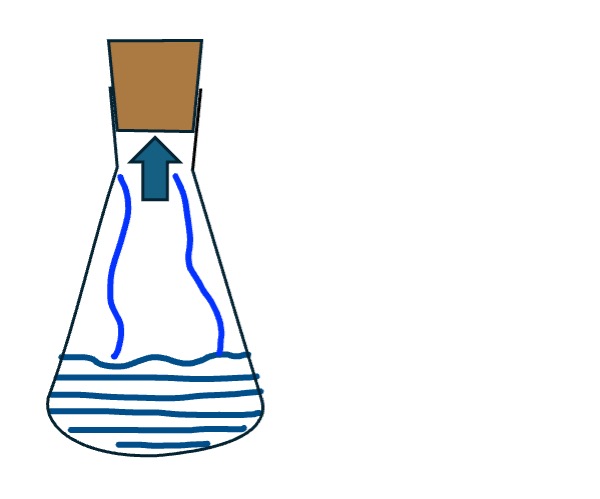
Vapour pressure measurements are fundamental in physical chemistry to probe interactions in liquid solutions. Vapor pressure is also what will tell you whether a perfume ingredient is a base note, heart note, or top note!
Upcoming talk on vapor pressure measurements applied to perfumes at the Institute of Art and Olfaction. Although the talk will not be posted online, a follow up is planned for the upcoming year which will be. (Image above: a liquid in a flask, establishing an equilibrium with its vapor phase.)